
Last updated
System Architecture
OpenCandle is an open source financial investigator. You ask a question in the web app at web.opencandle.app, the local GUI, or the terminal (TUI); OpenCandle figures out what kind of investigation it is, gathers evidence from finance tools, keeps the trace visible, and produces an answer that names risks and data gaps.
It is not an automated trading system and it is not a financial advisor. It is research software built to make the evidence path inspectable.
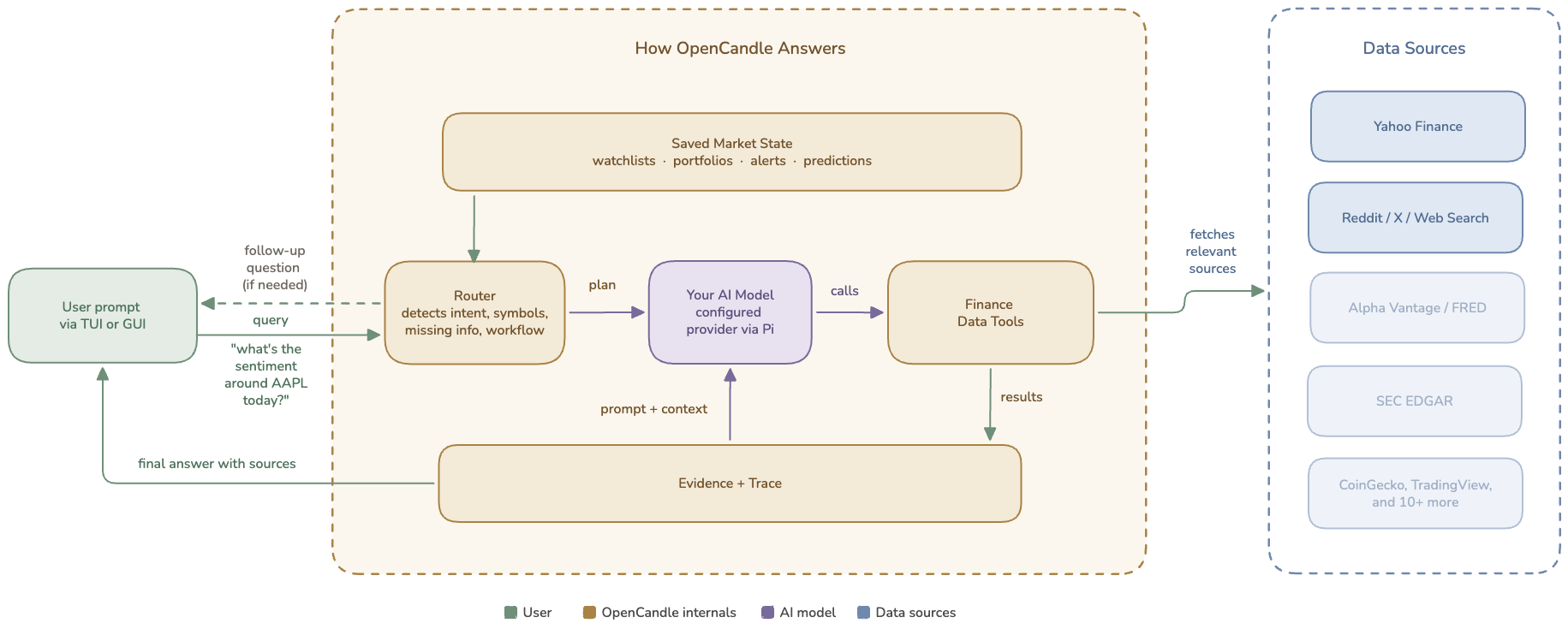
The Everyday Flow
User question
  |
  v
Understand the financial task
  - symbols, companies, assets, portfolio details
  - time horizon, risk profile, budget, strategy, or missing details
  - whether this is education, comparison, portfolio review, options, sentiment, filings, macro, or state tracking
  |
  v
Choose an investigation path
  - use a structured workflow when the user asks for one
  - otherwise prepare a finance-specific evidence plan for the question
  - ask a focused follow-up only when the missing detail changes the answer
  |
  v
Gather tool-backed evidence
  - quotes, histories, options chains, fundamentals, filings, macro data
  - sentiment, web/news context, portfolio state, risk, correlations, backtests
  - provider freshness, missing credentials, stale cache, or degraded data
  |
  v
Produce the answer
  - cite what was actually checked
  - separate facts from judgment
  - call out uncertainty and downside scenarios
  - answer directly when the user asks for a decision or tradeoff
User Interfaces
OpenCandle has three surfaces.
The terminal UI is the fastest way to work from the keyboard. It supports normal chat, slash commands, model setup, provider connection, and saved Pi sessions.
The local GUI is a browser workbench at http://127.0.0.1:14567. Its home is a market dashboard (an indices strip, watchlist movers, a portfolio summary, and alerts status), and it adds per-symbol pages with interactive charts, chat answers rendered as chart cards, session history, a tool/workflow catalog, and a settings page covering model, data providers, saved preferences, notifications and automation, diagnostics, and data and privacy.
The web app at web.opencandle.app is the same agent and tools running entirely in your browser via an in-browser Node runtime, with nothing to install and your data kept in the browser. See How the Web App Works for details.
All three surfaces use the same OpenCandle session and finance tools. The GUIs add richer rendering and easier discovery; neither is a separate agent.
Workflows And Regular Questions
Some prompts map cleanly to visible workflows:
| Workflow | Use it for |
|---|---|
| Comprehensive Analysis | A broad single-asset investigation such as /analyze NVDA. |
| Compare Assets | Side-by-side comparison of stocks, ETFs, crypto assets, or funds. |
| Portfolio Builder | Building a proposed allocation from goals, budget, horizon, and risk preference. |
| Options Screener | Looking at calls, puts, covered calls, protective puts, expirations, and Greeks. |
Regular chat questions still get structure. For example:
- "Does adding NVDA make sense if I already own AAPL and TSLA?"
- "Is this SPY/MSFT retirement portfolio too risky?"
- "Is ARMH still the right ticker for Arm?"
- "Should I keep cash in HYSA, T-bills, CDs, or a bond ETF?"
Those are not just freeform replies. OpenCandle still extracts the relevant entities, chooses useful evidence, asks for clarification when needed, and applies the right answer shape for the task.
Clarifying Questions
OpenCandle should ask a follow-up only when the missing information materially changes the investigation.
Good examples:
- An unknown ticker appears in an earnings-risk question.
- An options request is missing the underlying position.
- A portfolio-construction request has no budget, horizon, or risk preference.
In the GUI, these appear as question cards in the chat. After you answer, OpenCandle continues the investigation and uses tools; it should not stop at a generic response.
Tools And Providers
Tools are small finance capabilities. They fetch and format data. They should not invent market facts or make the final investment conclusion. Provider helpers add caching, rate limiting, fallback behavior, and degraded-state metadata; if a provider is missing, stale, or unavailable, that shows up in the result instead of being hidden.
The full domain-by-domain map of tools and providers lives in Data Sources.
Evidence And Answer Quality
OpenCandle answers should be useful because the evidence is visible and the answer shape matches the question.
Expected behavior:
- A current-price question should show the quote source and freshness.
- A portfolio-risk question should discuss concentration, horizon, drawdown, and simple adjustments.
- An options question should distinguish per-share option quotes from standard 100-share contract cost.
- A ticker mismatch should be treated as a red flag before discussing social hype.
- A filing question should separate SEC filing evidence from news or market context.
- A pure education question should avoid unnecessary tool calls.
GUI Runtime
The GUI server serves the built browser app, reads the current Pi session, and streams chat/session updates. Browser and terminal windows coordinate through the local server, so the same session can be open in several places without conflicting writes. See GUI Quickstart for local usage and Tailscale access. The hosted web app has no local server; its runtime is described in How the Web App Works.
Useful local GUI endpoints:
GET /healthreturns whether the process is alive plus diagnostic coordination metadata.GET /api/bootstrapreturns the initial catalog, setup state, sessions, prompts, and current snapshot.GET /api/sessionslists saved sessions.GET /api/session/eventsreturns the current projected chat events.POST /api/local-coordinator/chat-runsubmits one session-addressed chat run through the local coordinator.GET /api/instruments/overviewreturns cached company profile and key stats for one symbol (backs the symbol pages).GET /api/instruments/historyreturns validated range/interval history bars with request coalescing (backs the interactive charts).GET /api/market-state/indicesreturns the cached dashboard indices snapshot, including each instrument'sassetType; chart data is fetched separately.GET /api/market-state/sparkline?symbol=<symbol>&assetType=<type>returns a size-bounded, validated Ticker Line SVG for a trusted GUI browser session. Addmetadata=1to receive its source and exact data-as-of timestamp as JSON.GET /wsprovides live updates for setup, catalog, session, and ask-user events.
Local State
OpenCandle state defaults to ~/.opencandle/ for the local GUI and terminal; the state files and env overrides are documented in Configuration. The web app keeps its state in your browser instead.
Common files:
config.jsonfor provider keys and file-backed settings.state.dbfor memory, workflow state, and durable user market state such as instruments, watchlists, portfolio lots, alerts, report runs, and import provenance.sentinel.dbfor sentiment trend state.onboarding.jsonfor provider setup, snooze, never-ask, and welcome state.
Pi owns its own runtime config and session storage separately. OpenCandle should not depend on repo-local .pi/extensions/ artifacts.
Validation
OpenCandle uses layered validation:
- Unit tests for deterministic logic, mocked providers, and GUI state helpers.
- End-to-end tests for CLI, credential flows, and live provider/tool behavior when needed.
- Browser smoke tests for the local GUI.
- Full-session evals that check whether the agent chose the right investigation path, used relevant tools, disclosed gaps, framed risk, and answered the user directly.
- Competitive evals that compare OpenCandle against generic agents on realistic finance prompts.
See Testing and Evals.